Case study: a foundry website and SEO optimization
Most B2B clients don’t come to a website by chance. They already know what they need and are looking for a specific technology, material or product. That’s why an engineer is unlikely to type “metal casting” into Google. Much more often it will be “custom bronze casting”, “centrifugal bushing casting”, “gears made to drawing” or a query with the name of their city. That’s exactly the problem we faced while working on the website of Megaresurs-Ukraine LLC.

The starting point: a 5-page foundry website
This case study is about the Megaresurs foundry website and how it grew into a full SEO structure. When work began, the site consisted of just five pages:
- home;
- about the company;
- products;
- gallery;
- contacts.
Meanwhile the company itself had much broader production capabilities: casting steel, cast iron, bronze, brass and copper, various production technologies, a wide range of products and deliveries across Ukraine.
Practically all of this information was gathered on a single page, which seriously limited its visibility in search engines.
Building the structure started with keywords
Instead of mechanically adding new pages, we first analyzed how potential customers search for similar services. As a result, the whole structure was built around four main search directions:
- technologies (lost foam, centrifugal, gravity casting);
- materials (steel, cast iron, bronze, brass);
- product types (bushings, gears, housings, plates, etc.);
- geography (pages for Ukrainian cities).
Each of these directions received separate landing pages with their own structure, content and optimization. As a result, instead of five generic pages, an SEO structure of about forty pages was created, with a special place for regional pages for cities where the company regularly works with customers.

Unique content instead of templates
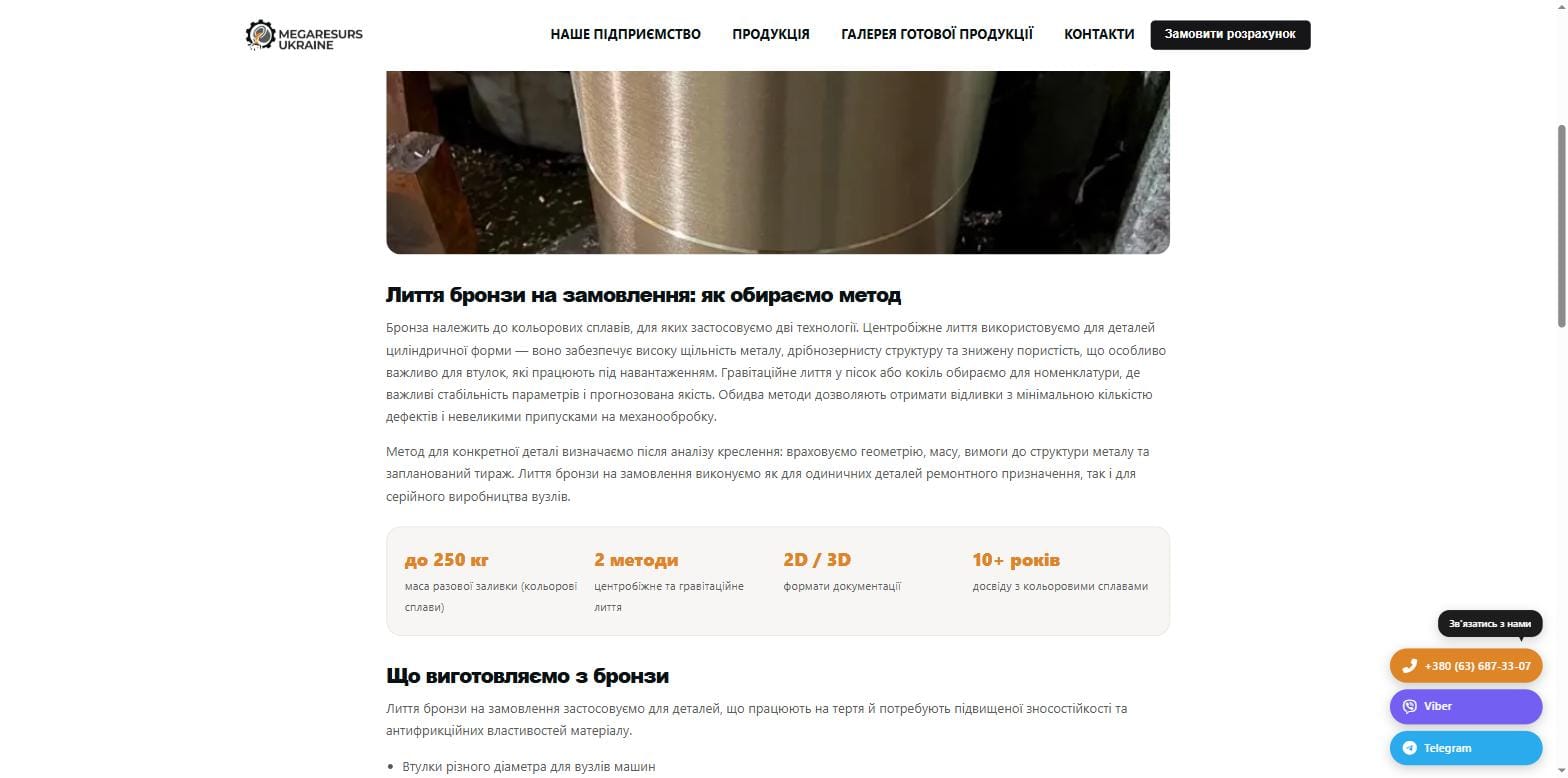
Creating a large number of pages makes no sense if they duplicate each other. So separate material was prepared for each page to match a specific search query. For example, the bronze casting page describes:
- the specifics of working with bronze alloys in particular;
- the relevant production technologies;
- where the parts are used;
- production limits;
- the list of products the company makes from this material.
This way each page became a separate answer to a specific user query, not a variation of the same text.
Comprehensive SEO optimization
In parallel, full technical optimization of the site was carried out.
For each page we prepared:
- unique Titles and Descriptions;
- a logical H1–H3 heading structure;
- optimized URLs;
- image alt text;
- internal linking;
- structured data markup;
- loading speed optimization.
As a result, every page became clear not only to users but also to search engines.
Maximum specifics
In the industrial segment, decisions are made based on technical capabilities, not marketing promises. So we completely changed how the information is presented. Instead of general phrases about quality or professionalism, the site contains specific production parameters:
- single pour of ferrous alloys — up to 850 kg;
- non-ferrous alloys — up to 250 kg;
- casting diameter — from 20 to 2200 mm;
- working with 2D and 3D drawings;
- preliminary machining of parts.
It’s these specifications that help a potential client quickly assess whether the company is right for their task.

Describing technologies without unnecessary theory
A separate section is dedicated to casting methods. Each technology got its own block with a brief explanation:
- which materials it’s used for;
- which products are best made with this method;
- what advantages it offers depending on the part’s design.
This format helps visitors find their way faster, even if they’re not process engineers.

One main interaction scenario
Analyzing potential clients’ behavior made it clear: most of them already have a drawing of the part. So the main target action on the site became not “Leave a request” or “Book a consultation” but “Send a drawing”. The form supports uploading technical documentation in popular formats, which allows moving straight to project evaluation without extra back-and-forth. A consultation is still available, but as a secondary scenario for those at an early stage of preparation.
A transparent work process
So users understand what will happen after sending a drawing, we added a separate block with the workflow:
- receiving the request;
- analyzing the drawing;
- agreeing on technical parameters;
- preparing a commercial proposal;
- production;
- shipping the finished products.
This scenario helps make the process clearer and more predictable even before the first contact with the company.

Communication in familiar channels
In the B2B segment, response speed is often decisive.
So the site has a quick contact panel with phone, Viber and Telegram, letting the client choose the most convenient way to communicate.
Design: not prettier, but clearer
The visual design was also completely refreshed. The main focus is on readability, contrast and easy navigation. The design uses photos of real production and finished castings instead of template illustrations, which strengthens trust in the company. Every interface element serves two tasks: helping people quickly find the information they need and guiding them toward sending a drawing.
Result
As a result of the project, the site turned from a compact corporate presentation into a full-fledged tool for attracting B2B leads.
The new structure made it possible to:
- cover a much broader set of keywords;
- create separate landing pages for different search intents;
- make the information clearer for potential customers;
- shorten the path from search to sending a drawing.
Conclusion
For manufacturing companies, an effective website is more than a service catalog.
It’s a system that works with SEO, answers potential clients’ technical questions and helps bring in targeted inquiries faster.
That’s the principle we used to build the website for Megaresurs-Ukraine LLC: from analyzing search demand to structure, content and interaction scenarios that work to attract new orders. Write to us — we’ll look at your case and tell you honestly what will work and what won’t.